Xeomin and Dysport are botulinum toxin type A products, but they are not interchangeable. Their formulations, ingredients, labeled cosmetic uses, and proprietary potency units differ. A useful Xeomin vs Dysport comparison must therefore look beyond unit counts and promotional claims about speed, purity, diffusion, or duration.
For aesthetic practices, the correct question is not which product is universally better. It is which product fits the intended treatment area, patient-specific assessment, provider experience, practice formulary, and sourcing requirements.
This guide compares the label-supported differences providers should understand before evaluating Xeomin for their practice.
Understanding Xeomin
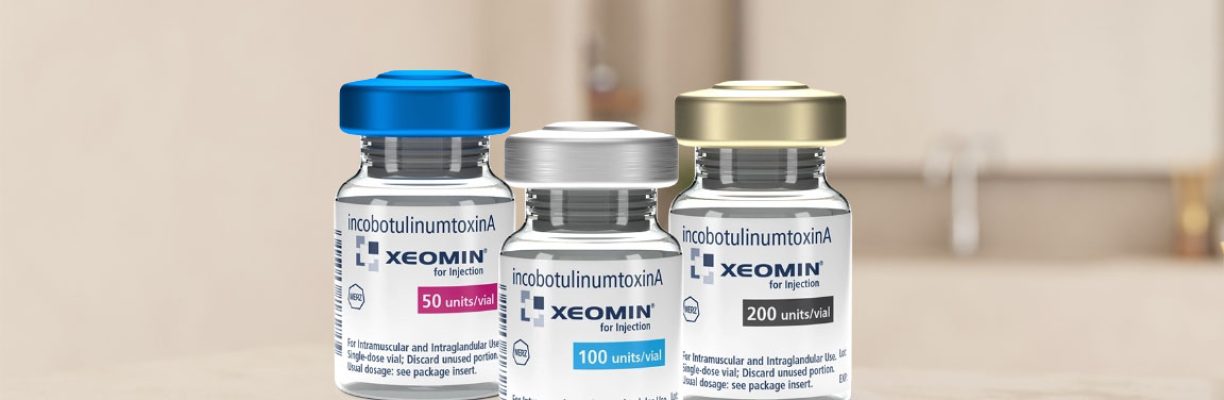
Xeomin is the brand name for incobotulinumtoxinA, a botulinum toxin type A product. It inhibits the release of acetylcholine at peripheral nerve endings. In simpler terms, Xeomin temporarily reduces the nerve signal that tells a targeted muscle to contract.
In aesthetic medicine, this temporary reduction in muscle activity can soften expression-related lines caused or intensified by repeated facial movement. Current U.S. cosmetic labeling includes glabellar lines, horizontal forehead lines, and lateral canthal lines in adults.
Xeomin’s Formulation
During manufacturing, the active neurotoxin is separated from hemagglutinin and non-hemagglutinin proteins. The resulting 150-kDa active neurotoxin does not contain accessory proteins.
In plain language, Xeomin’s active neurotoxin is prepared without the additional proteins found in some botulinum toxin complexes. However, this does not mean that the finished vial contains only the active neurotoxin. Xeomin also contains human albumin and sucrose as inactive ingredients.
Terms such as “naked toxin,” “pure toxin,” or “additive-free” may oversimplify this distinction. The more precise description is that Xeomin is formulated without accessory or complexing proteins. That formulation characteristic alone does not establish that Xeomin is universally safer, more effective, or incapable of producing an immune response.
Understanding Dysport
Dysport is the brand name for abobotulinumtoxinA, another botulinum toxin type A product. It also inhibits acetylcholine release at peripheral nerve endings. Put simply, Dysport temporarily reduces the nerve signal responsible for contraction in the treated muscle.
In aesthetic medicine, this effect is used to improve the appearance of expression-related lines. Current U.S. cosmetic labeling indicates Dysport for the temporary improvement of moderate-to-severe glabellar lines associated with procerus and corrugator muscle activity in adults younger than 65.
Dysport’s Formulation
Dysport contains abobotulinumtoxinA as part of a neurotoxin complex with associated proteins. Its inactive ingredients include human albumin and lactose. Its prescribing information also states that the product may contain trace amounts of cow’s milk protein.
For most readers, the practical point is that Dysport has a different protein and inactive-ingredient profile from Xeomin. Dysport is contraindicated in patients with known hypersensitivity to cow’s milk protein. This is different from ordinary lactose intolerance, which involves difficulty digesting lactose rather than an immune reaction to milk protein.
Providers should evaluate this product-specific contraindication against the patient’s documented allergy and medical history.
Which Cosmetic Areas Are Included in Each U.S. Label?
Current U.S. prescribing information indicates Xeomin for temporary improvement in the appearance of moderate-to-severe:
- Glabellar lines associated with corrugator or procerus muscle activity
- Horizontal forehead lines associated with frontalis muscle activity
- Lateral canthal lines associated with orbicularis oculi muscle activity
These cosmetic indications apply to adult patients.
Dysport is indicated cosmetically for temporary improvement in moderate-to-severe glabellar lines associated with procerus and corrugator muscle activity in adults younger than 65. Its medication guide states that safety and effectiveness for treating other wrinkles have not been established in the labeling.
Treatment outside a product’s labeled cosmetic indication is considered off-label. The treating clinician should determine whether a proposed use is appropriate and explain the supporting rationale, product-specific risks, and available alternatives.
The difference in labeled treatment areas is one of the clearest, most verifiable distinctions in this comparison. It should be evaluated before broader claims about product preference or practice fit.
Why Xeomin and Dysport Units Cannot Be Compared Directly
Xeomin and Dysport use proprietary potency assays. Both prescribing labels state that their biological activity units are specific to the product and cannot be compared with or converted into the units of another botulinum toxin preparation.
This means:
- A higher Dysport unit count does not automatically indicate a stronger treatment
- A lower advertised price per unit does not establish a lower treatment cost
- A fixed Xeomin-to-Dysport conversion should not be assumed
- Cross-product purchasing decisions should not rely on unit numbers alone
Practices should instead evaluate total product acquisition cost, the complete treatment plan, provider familiarity, anticipated utilization, inventory turnover, and applicable storage and handling requirements.
When a practice conducts a Botox alternatives comparison, the same principle applies. Product-specific units, labeled indications, formulation, clinical judgment, and total treatment economics provide more useful information than a simple unit-price ranking.
Does Dysport Work Faster Than Xeomin?
Onset is frequently used as a product differentiator, but it should not be presented as a guaranteed patient outcome.
Manufacturer materials, clinical studies, and practice observations may use different endpoints when describing onset. One source may measure the first visible change, while another measures investigator-assessed improvement, patient satisfaction, or maximum treatment effect.
Several variables can also affect when a patient notices a response:
- Treatment area
- Dose selected
- Injection placement
- Facial anatomy
- Baseline muscle activity
- Previous botulinum toxin exposure
- The endpoint used to define onset
Some commonly cited neuromodulator differences, including speed, diffusion, and duration, may depend on study methodology and treatment context. A provider should not convert generalized product messaging into a universal prediction for every patient.
Does One Product Last Longer?
Duration is also influenced by more than the product name. The treated muscle group, dose, placement, muscle strength, previous response, retreatment threshold, and outcome definition can affect how long a result is considered clinically meaningful.
Dysport’s labeling reports reduced glabellar-line severity for up to four months in the clinical studies described in its prescribing information. That statement should not be interpreted as a direct head-to-head conclusion that one product lasts longer than another.
Without an appropriately designed direct comparison, practices should avoid publishing categorical statements that Xeomin or Dysport always lasts longer.
A patient’s documented response across previous treatment cycles may provide more useful decision support than a generalized brand claim.
Is Xeomin Better Because It Has No Accessory Proteins?
The absence of accessory proteins is a legitimate formulation distinction. It does not, by itself, establish that Xeomin is clinically superior for every patient or practice.
Product selection should not rest on a single molecular characteristic. Providers must also consider:
- The intended treatment area
- Current prescribing information
- Patient-specific contraindications
- Previous treatment response
- Anatomy and muscle recruitment
- Desired treatment outcome
- Provider training and experience
- Practice formulary and inventory requirements
Xeomin may fit practices that want a botulinum toxin type A option without accessory proteins. That is different from claiming that other formulations are inherently inappropriate or inferior.
How Should Aesthetic Practices Compare the Two Products?
A structured product review reduces the risk of selecting a neuromodulator based on incomplete marketing claims.
1. Start with the intended treatment area
Compare the planned use with the cosmetic indications included in each current U.S. label.
2. Review contraindications and patient history
Account for hypersensitivity, prior reactions, neuromuscular conditions, infection at the proposed injection site, medication history, and previous botulinum toxin exposure.
3. Separate established facts from clinical preferences
Formulation, ingredients, and labeled indications can be verified through official prescribing information. Preferences concerning handling, onset, diffusion, or aesthetic effect may depend more heavily on experience and treatment context.
4. Evaluate prior treatment response
Document the product used, dose, injection locations, response, adverse effects, duration, and reason for switching or continuing.
5. Compare total treatment economics
Do not compare proprietary units as though they were a shared currency. Assess acquisition cost, expected utilization, treatment-plan pricing, inventory turnover, and potential product waste.
6. Review operational fit
Consider staff familiarity, ordering requirements, storage instructions, reconstitution procedures, documentation, and supplier reliability.
7. Confirm the sourcing channel
The product decision and supplier decision are separate. Once a practice selects a product, it should confirm distributor licensing, buyer verification, traceability, product documentation, and the absence of gray-market inventory.
Safety Considerations Apply to Both Products
Both products carry boxed warnings concerning the potential distant spread of botulinum toxin effects. Reported symptoms can include generalized muscle weakness, double or blurred vision, eyelid drooping, swallowing or speech difficulty, and breathing problems. Symptoms have been reported from hours to weeks after injection.
Both products are contraindicated in patients with hypersensitivity to relevant botulinum toxin products or formulation components and in patients with infection at a proposed injection site. Dysport also lists cow’s-milk-protein hypersensitivity as a contraindication.
This article is educational and does not replace current prescribing information, clinical judgment, patient assessment, or applicable professional requirements.
Xeomin vs Dysport: The Provider Takeaway
The practical Xeomin vs Dysport decision begins with the intended treatment area, current prescribing information, patient-level assessment, and provider judgment. It should not begin with unit count, advertised unit price, or generalized claims that one product is faster, purer, stronger, or more natural.
Xeomin offers a formulation without accessory proteins and currently carries cosmetic indications for glabellar, horizontal forehead, and lateral canthal lines in adults. Dysport uses a different formulation and is labeled cosmetically for glabellar lines in adults younger than 65. Their potency units remain product-specific and nonconvertible.
Once a licensed practice determines that Xeomin belongs in its neuromodulator portfolio, the next step is to evaluate the supplier’s credentials, sourcing channel, account-verification process, documentation, and current product availability.
Frequently Asked Questions
What is the main difference between Xeomin and Dysport?
Xeomin and Dysport differ in formulation, inactive ingredients, current labeled cosmetic uses, and proprietary potency units. Xeomin’s active neurotoxin is separated from accessory proteins. Dysport contains a neurotoxin complex with associated proteins.
When comparing Xeomin vs Dysport, is one universally better?
No. The appropriate product depends on the proposed treatment area, patient history, contraindications, prior response, treatment goals, provider experience, and practice-level considerations. Formulation alone does not establish universal clinical superiority.
Which cosmetic indications are listed for Xeomin?
Current U.S. labeling includes temporary improvement of moderate-to-severe glabellar, horizontal forehead, and lateral canthal lines in adults.
Which cosmetic indication is listed for Dysport?
Dysport is labeled for temporary improvement of moderate-to-severe glabellar lines in adults younger than 65.
Can Xeomin and Dysport units be converted?
No. The potency units for each product are specific to its preparation and assay. The labels state that the units cannot be directly compared with or converted into units of another botulinum toxin product.
Is Xeomin additive-free?
No. Xeomin is formulated without accessory proteins, but its inactive ingredients include human albumin and sucrose.
Is Xeomin safer because it does not contain accessory proteins?
The absence of accessory proteins does not establish that Xeomin is safer for every patient. Both products have product-specific warnings, contraindications, and clinical considerations that must be reviewed before use.
Does Dysport contain milk protein?
Dysport contains human albumin and lactose and may contain trace cow’s milk protein. Known hypersensitivity to cow’s milk protein is listed as a contraindication.
Is price per unit a reliable way to compare Xeomin and Dysport?
No. Because the units are product-specific and cannot be converted, price per unit does not provide a valid direct comparison. Practices should assess total acquisition cost, the complete treatment plan, product utilization, and inventory considerations.
Where can licensed practices obtain current Xeomin sourcing information?
Licensed practices can review DeWitt Pharma’s Xeomin wholesale page and submit a provider account application. DeWitt verifies professional accounts before approval, and current availability should be confirmed during the account process.